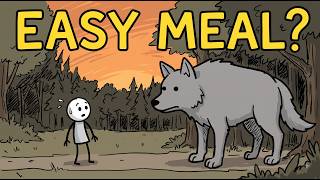
Why Do Predators Watch Children But Rarely Attack?
Long-form12:43People & BlogsPublished Oct 17, 2026, 11:04 AM · 5d ago

Views
793
+0 views/hour
Views / hour now
0
measured 1h ago
Peak views / hour
9
22h ago
First 24 hours
—
not tracked from upload
Engagement
0.8%
likes + comments / views
Likes
4
0.5% of views
Comments
2
0.25% of views
Est. ad revenue
$3–$8
lifetime, $4–10 RPM
Checked every 3 h while the video is this age · last check 1h ago · next in 68 min. YouTube itself updates public counts with a short delay.
Avg views / day
143
since upload
vs channel median
0.2×
this video's views ÷ the channel's usual
Rank in channel
#19
of 22 tracked
Views over time
18 readings
Total views Views gained per hour
Description
A six-year-old wanders to the edge of the campsite. Twenty feet away, in the tall grass, something is watching her. It's faster than any human alive, with claws that open a deer like an envelope. And it does nothing. It just follows.
Here's the uncomfortable part: to a cougar, a standing child is almost exactly the size of its favorite prey. Yet across the entire US and Canada, cougars attack people only a handful of times a year. Something cancels the signal, and it isn't kindness.
In this video:
🐾 The follow: why predators "audit" before they ever attack, and the movement that flips the switch
👤 The giant shadow: the shocking number about children who are alone
🧍 The shape: why standing tall confuses predators, and the posture parents should never use
👃 The scent: why we smell like danger to wild animals
🔊 The sound that made pumas abandon their own fresh kills
🐕 The ally we built: how a wolf became a child's guardian
And the final twist flips the comforting bedtime story completely upside down.
⚠️ Safety first: in mountain lion country, keep children close and never let them run ahead. If you see a big cat, don't run or crouch. Stand tall, make yourself look big, and pick up small children without bending over. Always follow your local park's wildlife guidance.
💬 Have you ever spotted a wild animal watching you on a hike? Tell us what happened!
🔔 Subscribe to Poko for more fun animal science that explains the wild world (and you!).
📚 Based on research including Mattson et al. (2011), Human–Wildlife Interactions; Smith et al. (2017), Proceedings of the Royal Society B; and US National Park Service safety guidance.
#Poko #AnimalFacts #MountainLion #Wildlife #AnimalBehavior #HikingSafety #NatureFacts #Predators
Details
- Published
- Oct 17, 2026, 11:04 AM
- Length
- 12:43 (763 s)
- Format
- Long-form
- Category
- People & Blogs
- Audio language
- EN
- Quality
- HD
- Captions
- No
- Made for kids
- No
- Licensed content
- Yes
- Video ID
- OmZdztW0VLQ
More from Poko
 Why Would a Wild Animal Trust Us When It’s in Trouble?98 views · 8h ago
 Why Wild Animals Fear One Unarmed Human More Than a Lion ?1.5K views · 1d ago
 Why Do Wild Animals Come Closer When You’re Alone?9.4K views · 2d ago · +286/h
 Why Do Predators Walk Away When a Human Stops Moving? (original) !!!1.1K views · 3d ago
 Why Do Wild Mothers Bring Their Babies Toward Humans ?4.3K views · 6d ago · +1/h
 Why Do Some Animals Trust Us With Their Babies?5.2K views · 1w ago
 Wild Animals Remember Your Face (And They Hold Grudges) !!!717 views · 1w ago
 Why Wild Animals Walk Right Up to Calm People ?7.4K views · 1w ago
Statistics from the YouTube Data API, tracked by FameX. Views per hour, revenue and comparisons are FameX estimates.