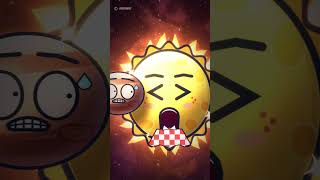
The Sun Tried Speed Dating Other Stars?! 💘
Long-form9:152.9× channel median
Published Oct 7, 2026, 9:00 PM · 6d ago

Orbitimbre
14.2K subscribers · median 10.3K views
Animation · confirmed$Likely
Views
29,649
+90 views/hour
Likes
322
1.1% of views
Comments
40
0.14% of views
Checked every 3 h while the video is this age · last check 2h ago · next in 37 min. YouTube itself updates public counts with a short delay.
Views / hour now
90
measured 2h ago
Peak views / hour
90
2h ago
Avg views / day
4.5K
since upload
First 24 hours
—
not tracked from upload
vs channel median
2.9×
Rank in channel
#16
of 20 tracked
Engagement
1.2%
likes + comments / views
Est. ad revenue
$119–$296
lifetime, $4–10 RPM
Views over time
1 readings · line: total views · bars: views gained per hour
Live tracking started
The chart fills in as FameX records new readings.
Description
Original 2D space animation by Orbitimbre.
Cosmic challenges, planet stories, and surprising endings.
Join the Orbitimbre crew for custom emoji and loyalty badges:
https://www.youtube.com/channel/UCtPoouzahVkQOs2gA206XRw/join
The Sun has been single for 4.6 billion years. Tonight, he has a date.
The planets panic: a second star close by could stretch, scramble, or even throw their orbits away. So they launch Operation Bad Date and crash a cosmic speed-dating show: a Brown Dwarf, a Pulsar who already has three planets, a Black Hole and a White Dwarf. Every dealbreaker is a real fact about stars. Then the "perfect" Blue Supergiant walks in... and her gravity starts pulling the whole family away.
Stay to the end: a real star is heading our way.
Chapters:
0:00 The Sun has a date
1:05 Single for 4.6 billion years
2:09 Operation Bad Date
2:56 Speed dating the galaxy
5:13 The one
6:28 Too close
7:07 The dance
8:09 Someone's coming
Science notes:
- The Sun is about 4.6 billion years old; sunspots come and go in a cycle of about 11 years.
- Nearly half of Sun-like stars have at least one companion star. Alpha Centauri A and B circle each other about every 80 years; Proxima takes roughly half a million years for one lap.
- Brown dwarfs have about 13 to 80 times the mass of Jupiter, too little to fuse hydrogen like the Sun.
- The first planets ever confirmed outside our Solar System (1992) orbit a pulsar, PSR B1257+12, which spins about 161 times a second.
- Close to a black hole, the near side is pulled harder than the far side: spaghettification.
- In about 5 billion years the Sun should swell into a red giant, then shrink into a white dwarf about the size of Earth.
- Blue supergiants shine tens of thousands of times brighter than the Sun and live only millions of years before many of them explode as supernovae. If one shone from where the Sun is, Earth's oceans would boil away.
- The "what if" scenes are thought experiments: no star like that is coming. A heavy second
Details
- Published
- Oct 7, 2026, 9:00 PM
- Length
- 9:15 (555 s)
- Format
- Long-form
- Category
- —
- Audio language
- —
- Quality
- —
- Captions
- —
- Made for kids
- —
- Licensed content
- —
- Video ID
- dCGEq27PTR0
More from Orbitimbre
 Can a Tiny Star Beat the Giants?! ⭐4.9K views · 19h ago · +211/h
 Can One Tiny Needle Hurt Earth? #earth #speedoflight #space #animation55.3K views · 1d ago · +723/h
 Do All Planets Fit Between Earth & Moon?186K views · 1d ago · +4.2K/h
 Who Would the Sun Date?78.4K views · 2d ago · +438/h
 Which Planet Has the Longest Day?69.5K views · 2d ago · +364/h
 How Small Is Earth, Really?178K views · 3d ago · +756/h
 Who Made Saturn's Rings?7.5K views · 3d ago · +31/h
 Can the Sun Get Fat?169K views · 3d ago · +504/h
Statistics from the YouTube Data API, tracked by FameX. Views per hour, revenue and comparisons are FameX estimates.