Education & explainersRainbow Balls SimulationFrom an Atom to 92 Billion Light-Years | Universe Size Comparison
From an Atom to 92 Billion Light-Years | Universe Size Comparison
Long-form24:00People & BlogsPublished Sep 29, 2026, 4:59 AM · 3w ago

Views
323
+0 views/hour
Views / hour now
0
measured 6h ago
Peak views / hour
—
First 24 hours
—
not tracked from upload
Engagement
0.3%
likes + comments / views
Likes
1
0.3% of views
Comments
0
0.00% of views
Est. ad revenue
$2–$4
lifetime, $4.8–12 RPM
Checked every 12 h while the video is this age · last check 6h ago · next in 300 min. YouTube itself updates public counts with a short delay.
Avg views / day
14
since upload
vs channel median
0.5×
this video's views ÷ the channel's usual
Rank in channel
#18
of 20 tracked
Views over time
6 readings
Total views Views gained per hour
Description
How small is an atom — and how big is the observable Universe? Travel through 64 scales in a continuous size comparison, from a hydrogen atom to a region roughly 92 billion light-years across.
Watch cells become tiny beside everyday objects, planets shrink next to stars, and entire galaxies disappear into the scale of the observable Universe. A continuous camera move connects every step in this 24-minute journey, presented in 4K at 60 FPS.
CHAPTERS
00:00 Atoms & molecular machines
01:59 Living cells
03:33 Everyday objects
05:05 Instruments of discovery
06:33 Engineering giants
08:51 Small worlds
11:29 Icy moons & dwarf planets
13:36 Rocky worlds & giant moons
15:19 Giant planets
16:29 Stars & a supergiant
18:39 The outer Solar System
19:40 Clouds between the stars
21:12 Galaxies
22:39 Our cosmic neighbourhood
23:50 The observable Universe
ABOUT THE SIZES
Objects on screen share one linear scale. Labels identify the dimension being compared: diameter, width, length, height or regional extent. Natural sizes may vary, and the boundaries of nebulae, galaxies and other large regions depend on how they are measured.
The final scale is the OBSERVABLE Universe, not the whole Universe. The total size of the Universe is unknown. Surface details, colours and object spacing are illustrative; this is an animated size comparison, not a physical simulation.
SELECTED REFERENCES
Planet sizes — NASA JPL: https://ssd.jpl.nasa.gov/planets/phys_par.html
Moon sizes — NASA JPL: https://ssd.jpl.nasa.gov/sats/phys_par/
The observable Universe — NASA: https://www.nasa.gov/science-research/astrophysics/how-big-is-space-we-asked-a-nasa-expert-episode-61/
Which change in scale surprised you the most?
The track "Big Rock - Take the Lead" (artist: Kevin MacLeod) is licensed under the Creative Commons Attribution 4.0 license. https://creativecommons.org/licenses/by/4.0/
#SizeComparison #Universe #Space
Details
- Published
- Sep 29, 2026, 4:59 AM
- Length
- 24:00 (1,440 s)
- Format
- Long-form
- Category
- People & Blogs
- Audio language
- EN-US
- Quality
- HD
- Captions
- No
- Made for kids
- No
- Licensed content
- Yes
- Video ID
- pH6eMOJJu3o
More from Rainbow Balls Simulation
 COUNTRIES MARBLE RACE. 3D Balls Marble run518 views · 1w ago
 Colorful Marble Race — Who Will Beat the Obstacle Course? 🌈🏁1.2K views · 2w ago · +1/h
 Colorful Marbles vs Spinning Obstacles! 🌈 Marble Race 3D Blender simulation777 views · 2w ago · +1/h
 20 Cars, One Winner! 🏁 Colorful Toy Car Race | Micro Rally 3D Blender Simulations621 views · 3w ago
 80 Marbles, One Winner! 🌈 Color Rush Marble Race1.7K views · 3w ago · +1/h
 Can Thousands of Marbles Escape This Maze? 100,000 Marbles 3D Balls Simulation224 views · 3w ago
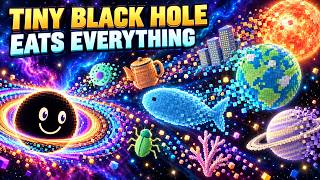 Tiny Black Hole Swallows the Universe 🌌 From an Atom to 160 Billion Light-Years252 views · 3w ago
 3D Marle Race with 80 Rainbow Balls. Blender Championship.1.8K views · 3w ago · +1/h
Statistics from the YouTube Data API, tracked by FameX. Views per hour, revenue and comparisons are FameX estimates.