Why Ancient Humans Were The Most TERRIFYING Animal Alive
Long-form9:07
Published Aug 7, 2026, 8:00 PM · 2mo ago

Ink Explainer
135K subscribers · median 301K views
Animation · confirmed$Likely
Views
256,188
+149 views/hour
Likes
2.8K
1.1% of views
Comments
344
0.13% of views
Checked every 24 h while the video is this age · last check 12h ago · next in 667 min. YouTube itself updates public counts with a short delay.
Views / hour now
149
measured 12h ago
Peak views / hour
149
12h ago
Avg views / day
3.6K
since upload
First 24 hours
—
not tracked from upload
vs channel median
0.8×
Rank in channel
#10
of 17 tracked
Engagement
1.2%
likes + comments / views
Est. ad revenue
$1,025–$2,306
lifetime, $4–9 RPM
Views over time
0 readings · line: total views · bars: views gained per hour
Live tracking started
The chart fills in as FameX records new readings.
Description
Why Humans Are the Most Terrifying Animal Alive
All research and sources are linked below.
📚 RESEARCH & SOURCES:
▸ Endurance running & persistence hunting — Bramble & Lieberman (2004, Nature 432:345–352). Our running anatomy is a trait of the genus Homo originating about 2 million years ago. https://doi.org/10.1038/nature03052
▸ High-speed throwing — Roach, Venkadesan, Rainbow & Lieberman (2013, Nature 498:483–486). Cocking the arm stores elastic energy in the shoulder like a slingshot and releases the fastest motion the human body makes; the anatomy appears together ~2 million years ago in Homo erectus. https://doi.org/10.1038/nature12267
▸ Chimpanzee strength — O'Neill et al. (2017, PNAS), "Chimpanzee super strength and human skeletal muscle evolution." Chimp muscle is ~1.35× stronger pound-for-pound, yet throws at only ~20 mph.
▸ Shared intentionality ("we" vs "I" mode) — Tomasello et al. (2012, Current Anthropology 53:673–692), "Two Key Steps in the Evolution of Human Cooperation," and Tomasello et al. (2005, Behavioral and Brain Sciences), "Understanding and sharing intentions."
▸ Megafauna extinctions — Sandom, Faurby, Sandel & Svenning (2014, Proc. R. Soc. B 281:20133254). Extinction severity tracks human arrival — minimal in Africa, severe in Australia and the Americas. https://doi.org/10.1098/rspb.2013.3254
▸ The human "super predator" — Darimont, Fox, Bryan & Reimchen (2015, Science 349:858–860). Humans kill adult prey at up to 14× the median rate of other predators, with especially intense exploitation of land carnivores and fish. https://doi.org/10.1126/science.aac4249
Experts@Minnesota
▸ Fear of the human voice (Africa) — Zanette, Frizzelle, Clinchy et al. (2023, Current Biology 33:4689–4696). Wildlife in Greater Kruger fled human speech far more than lion sounds, dogs, or gunshots. https://doi.org/10.1016/j.cub.2023.08.089
Phys.org
▸ Fear of the human voice (North America) — Smith et al. (2017, Proc. R. Soc. B) and Suraci et al. (2019, Ecol
Tags
ancient historyancient humansancient hum
Details
- Published
- Aug 7, 2026, 8:00 PM
- Length
- 9:07 (547 s)
- Format
- Long-form
- Category
- —
- Audio language
- —
- Quality
- —
- Captions
- —
- Made for kids
- —
- Licensed content
- —
- Video ID
- xmQk_oLVau0
More from Ink Explainer
 What Did Ancient Humans Actually Do all Night?74.2K views · 1w ago · +193/h
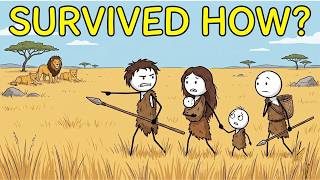 How Did Ancient Humans Survive the Deadliest Predators on Earth?93.8K views · 2w ago · +154/h
 What Did Ancient Humans Do For Pleasure?253K views · 6w ago · +78/h
 What Did Ancient Humans Actually Do All Day?14.4M views · 8w ago · +7.7K/h
 How Did Human Accidentally Invented Guns?56K views · 2mo ago · +47/h
 The Disturbing Ways Ancient Humans Survived Winter1M views · 3mo ago · +1.1K/h
 What Did Ancient Humans Do When It Rained All Week?1.7M views · 3mo ago · +549/h
 How Did Ancient Humans Travel the World?855K views · 3mo ago · +129/h
Statistics from the YouTube Data API, tracked by FameX. Views per hour, revenue and comparisons are FameX estimates.