Why Your Brain Erases Every Dream Before You Wake Up?
Long-form24:35EducationPublished Oct 17, 2026, 2:39 PM · 3d ago

Views
3,490
+0 views/hour
Views / hour now
0
measured 1h ago
Peak views / hour
66
16h ago
First 24 hours
—
not tracked from upload
Engagement
1.2%
likes + comments / views
Likes
32
0.9% of views
Comments
10
0.29% of views
Est. ad revenue
$17–$38
lifetime, $4.8–10.8 RPM
Checked every 3 h while the video is this age · last check 1h ago · next in 73 min. YouTube itself updates public counts with a short delay.
Avg views / day
1K
since upload
vs channel median
0.2×
this video's views ÷ the channel's usual
Rank in channel
#19
of 22 tracked
Views over time
8 readings
Total views Views gained per hour
Description
Every night, your brain switches off its memory “save” signal and sends in a dedicated cleanup system that wipes your dreams before you even open your eyes. But sleep research reveals a surprising twist: whether a dream survives depends less on having a good memory and more on staying awake for about two minutes before drifting back off.
In this video, we step inside your brain’s night-shift kitchen. You’ll find out why REM sleep cooks up wild stories, why dreams also happen outside REM, and how a chemical messenger called norepinephrine goes nearly silent while you dream. You’ll also see what a 2019 mouse study revealed about MCH brain cells that may actively clear memories during sleep.
We also explore two big theories about why your brain might want you to forget: Francis Crick’s “dream to forget” idea and Erik Hoel’s overfitted brain hypothesis. Then we bust a common myth about people who remember every dream, explain the two-minute rule, and share two simple tricks you can try tonight to catch a dream before it disappears.
Are you a night-waker or a straight-through sleeper? Watch to the end and tell us in the comments.
DISCLAIMER
This video is for educational and entertainment purposes only and does not provide medical advice. Some findings discussed come from animal studies or remain scientific hypotheses. Sleep research continues to evolve. If you experience persistent sleep problems, insomnia, or distressing nightmares, please consult a qualified healthcare professional for personalized guidance.
MAIN SOURCES
1. Izawa, S. et al. (2019). REM sleep–active MCH neurons are involved in forgetting hippocampus-dependent memories. Science, 365(6459), 1308–1313.
2. Aston-Jones, G. & Bloom, F. E. (1981). Activity of norepinephrine-containing locus coeruleus neurons in behaving rats anticipates fluctuations in the sleep-waking cycle. Journal of Neuroscience, 1(8), 876–886.
3. Siclari, F. et al. (2017). The neural correlates of dreaming. Nature Neuroscience, 20(6), 872–878.
4. Vallat, R. et al. (2017). Increased evoked potentials to arousing auditory stimuli during sleep: Implication for the understanding of dream recall. Frontiers in Human Neuroscience, 11, 132.
5. Elce, V. et al. (2025). The individual determinants of morning dream recall. Communications Psychology.
6. Crick, F. & Mitchison, G. (1983). The function of dream sleep. Nature, 304, 111–114.
7. Hoel, E. (2021). The overfitted brain: Dreams evolved to assist generalization. Patterns, 2(5), 100244.
#DreamScience #SleepFacts #Brain #Psychology #REMSleep
Tags
why do we forget dreamswhy your brain erases dreamsdream recallhow to remember dreamsREM sleepwhy we dreamdream sciencesleep sciencebrain during sleepforgetting dreams explainedtwo minute rule dreamsMCH neuronsnorepinephrine sleepoverfitted brain hypothesisFrancis Crick dream theorynon-REM dreaminghigh dream recallersdream journal tipspsychology of dreamshuman brain facts
Details
- Published
- Oct 17, 2026, 2:39 PM
- Length
- 24:35 (1,475 s)
- Format
- Long-form
- Category
- Education
- Audio language
- EN-US
- Quality
- HD
- Captions
- No
- Made for kids
- No
- Licensed content
- Yes
- Video ID
- bhFfVCa9bk0
More from Ancient Human Files
 Why Human Childbirth Is So Difficult (Evolution Explained)380 views · 10h ago · +15/h
 Why Evolution Kept Homosexuality (The Genetic Clue Hidden in Straight People)17.9K views · 1d ago
 Why Don’t Cats Fear Humans?4.9K views · 2d ago · +27/h
 Why You Talk to Yourself — The Science of Your Inner Voice17.9K views · 4d ago · +38/h
 Why Humans Can Eat Anything But Animals Can’t18K views · 5d ago · +11/h
 Why Can't You Tickle Yourself? The Science Explained3.9K views · 6d ago · +1/h
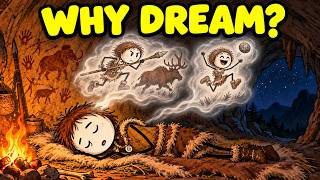 Why Do We Dream? What Your Brain Really Does While You Sleep26.1K views · 1w ago · +79/h
 Why Did Humans Start Having Sex in Private?3.9K views · 1w ago · +9/h
Statistics from the YouTube Data API, tracked by FameX. Views per hour, revenue and comparisons are FameX estimates.