Wooden Warships Were Far More Complex Than You Think
Long-form16:51
Published Feb 10, 2026, 2:16 PM · 8mo ago

Deconstructed
435K subscribers · median 1.1M views
Animation · confirmed$Likely
Views
2,053,238
+450 views/hour
Likes
26.9K
1.3% of views
Comments
740
0.04% of views
Checked every 24 h while the video is this age · last check 11h ago · next in 728 min. YouTube itself updates public counts with a short delay.
Views / hour now
450
measured 11h ago
Peak views / hour
450
11h ago
Avg views / day
8.3K
since upload
First 24 hours
—
not tracked from upload
vs channel median
1.9×
Rank in channel
#2
of 20 tracked
Engagement
1.4%
likes + comments / views
Est. ad revenue
$8,213–$18,479
lifetime, $4–9 RPM
Views over time
0 readings · line: total views · bars: views gained per hour
Live tracking started
The chart fills in as FameX records new readings.
Description
In this Deconstructed video, we rebuilt an entire 18th-century sailing warship piece by piece in full 3D to understand how ships of this era were built, how they operated at sea, and what daily life on board was really like. We take a close look at the internal framing, along with the ship’s rigging and deck layouts, explaining how each part worked in detail.
We also created a detailed cutaway poster inspired by the video, showing the ship from the keel to the tallest mast.
👉 Get the poster here, every order helps support the channel so we can keep creating projects like this: https://crowdmade.com/collections/deconstructed/products/deconstructed-eiffel-tower-poster
*(Giveaway ended)🎁 We are also giving one away. Just subscribe, like this video, and leave a comment below telling us: What surprised you the most about 18th-century sailing warships? We will announce the winner in our next upload. Details below.
The ship featured in this video is based on HMS Pegasus, a three-masted Swan-class sloop-of-war built for the Royal Navy in the late 18th century. Ships of this class represented a distinct category of warship during the Age of Sail, designed to be fast, versatile, and capable of operating independently across vast distances.
Featuring a single gun deck carrying up to 16 guns and constructed almost entirely from oak timber reinforced with a dense internal structure, vessels like Pegasus achieved a good balance between armament and sailing performance. Their three-mast rig allowed them to harness the wind efficiently, while their compact size made them ideal for patrols, escort duties, reconnaissance, and long overseas deployments. Crews lived and worked aboard these ships for months at a time, operating under demanding conditions that required skill, discipline, and coordination.
Chapters
00:00 – 02:01 18th Century Warships
02:01 – 03:19 Swan-Class Ship-Sloops
03:19 – 04:50 The Hull Structure
04:50 – 06:26 Masts, Sails, and Rigging
06:26 – 15:41 Deck Layou
Tags
sailing warship18th century warshiproyal navynaval historywooden warshipship of the linesloop of warhms pegasussailing shipshistoric shipsnaval engineeringmaritime historyhow warships workedlife on a warshipnaval cannons
Details
- Published
- Feb 10, 2026, 2:16 PM
- Length
- 16:51 (1,011 s)
- Format
- Long-form
- Category
- —
- Audio language
- —
- Quality
- —
- Captions
- —
- Made for kids
- —
- Licensed content
- —
- Video ID
- jO30q8FSyM8
More from Deconstructed
 Inside the Most-Produced Bomber of WWII | B-24 Liberator789K views · 3w ago · +266/h
 The 19th-Century Submarine That Simply Shouldn’t Exist2M views · 2mo ago · +188/h
 Ancient Greek Warships Were Nothing Like What You've Seen in Movies986K views · 3mo ago · +186/h
 We Finally Know What Actually Happened To The Hindenburg2.9M views · 4mo ago · +486/h
 Medieval Siege Weapons Were More Than Just Catapults1.3M views · 5mo ago · +223/h
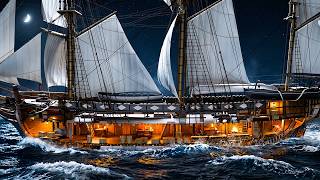 How an Explorer’s Sailing Ship Actually Worked | HMS Beagle600K views · 6mo ago
 How the First Modern Military Submarine Actually Worked858K views · 6mo ago · +86/h
 The Genius Design of Alcatraz666K views · 7mo ago · +60/h
Statistics from the YouTube Data API, tracked by FameX. Views per hour, revenue and comparisons are FameX estimates.