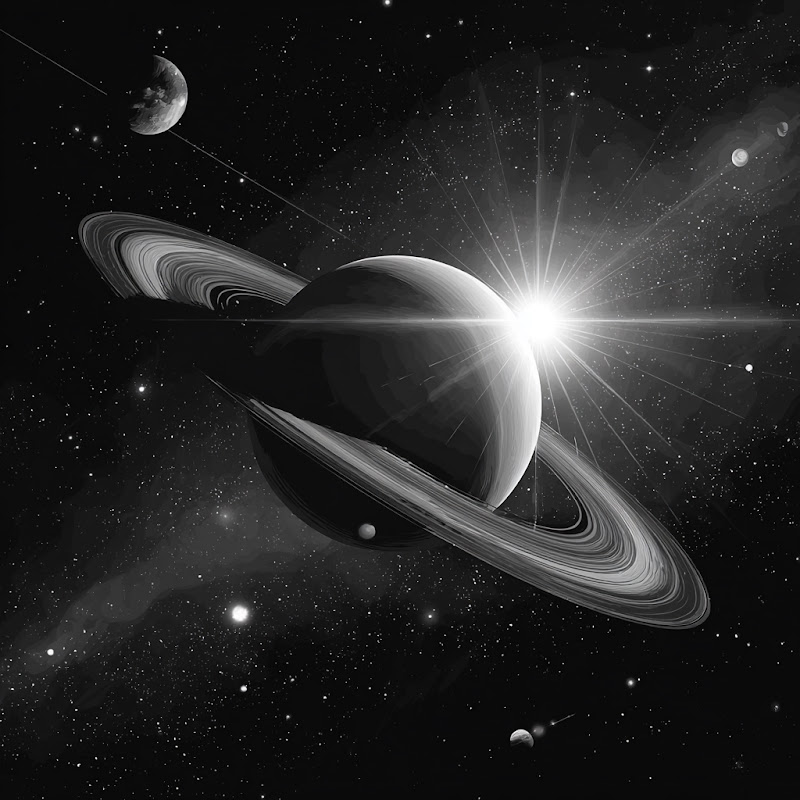
Why It's Impossible to Return From Saturn
Long-form1:53:19Science & TechnologyPublished Oct 7, 2026, 11:00 PM · 1w ago
Views
19,941
+3 views/hour
Views / hour now
3
measured 6h ago
Peak views / hour
3
6h ago
First 24 hours
—
not tracked from upload
Engagement
1.1%
likes + comments / views
Likes
195
1.0% of views
Comments
24
0.12% of views
Est. ad revenue
$104–$259
lifetime, $5.2–13 RPM
Checked every 12 h while the video is this age · last check 6h ago · next in 316 min. YouTube itself updates public counts with a short delay.
Avg views / day
1.5K
since upload
vs channel median
0.7×
this video's views ÷ the channel's usual
Rank in channel
#17
of 23 tracked
Views over time
2 readings
Total views Views gained per hour
Description
Saturn is not a place you land on. It is a gas giant with no solid surface, surrounded by over 140 moons, a vast ring system, and radiation belts that create one of the most complex environments in the solar system. A crewed mission to Saturn would take somewhere between ten and fifteen years round trip, requiring astronauts to carry every breath of air, every calorie of food, and every drop of propellant they will ever need for the entire journey. There is no resupply. There is no rescue. And past Jupiter, there is no turning back.
This documentary explores exactly why returning from Saturn is so extraordinarily difficult. We follow a hypothetical crew from Earth departure through years of interplanetary transit, orbital capture at Saturn, a potential landing on Titan, and the brutal reality of the return journey. Along the way, we examine the real engineering barriers: nuclear propulsion, closed-loop life support, radiation exposure far beyond any limit ever applied to human spaceflight, food that degrades over a decade, pharmaceuticals that expire before the crew needs them most, and a spacecraft that must function flawlessly for longer than anything humanity has ever built.
This is not a story about Saturn's gravity trapping you. It is a story about distance, time, and the gap between what we can imagine and what we can actually build. Saturn does not forbid a return. It simply demands a level of engineering self-sufficiency that does not yet exist.
Sources:
NASA/JPL-Caltech, "Cassini-Huygens Mission to Saturn," NASA Science, 2017. Cassini-Huygens - NASA Science
NASA, "About Radioisotope Power Systems," NASA Science, 2024. About Radioisotope Power Systems - NASA Science
NASA, "Nuclear Thermal Propulsion: Game Changing Technology for Deep Space Exploration," NASA Space Technology Mission Directorate, 2018. Nuclear Thermal Propulsion: Game Changing Technology for Deep Space Exploration
Johns Hopkins Applied Physics Laboratory, "Dragonfly Mission Confirmed for 2028 Launch to Saturn's Moon Titan," APL Press Release, 2024. Dragonfly Mission Confirmed for 2028 Launch to Saturn’s Moon Titan | Johns Hopkins University Applied Physics Laboratory
The Planetary Society, "Titan, a Moon with Familiar Vistas," The Planetary Society, 2025. Titan, a moon with familiar vistas
#Saturn #Titan #SpaceExploration #NuclearPropulsion #Cassini #DeepSpace #SolarSystem
Details
- Published
- Oct 7, 2026, 11:00 PM
- Length
- 1:53:19 (6,799 s)
- Format
- Long-form
- Category
- Science & Technology
- Audio language
- EN
- Quality
- HD
- Captions
- No
- Made for kids
- No
- Licensed content
- Yes
- Video ID
- IY0SHO4NQM8
More from Sleep On Science
 Why Have We Never Actually Seen Our Solar System From Above?9K views · 21h ago · +141/h
 Why Astronauts Who Go To Mars Will Never Come Home7.8K views · 1d ago · +2/h
 How Many Planets in the Universe Could ACTUALLY Support Alien Life?16.4K views · 2d ago
 The True Scale of the Solar System… And Where It Actually Ends28.1K views · 3d ago · +63/h
 The Distance Between Us and the Nearest Stars Is Far Worse Than You Think43K views · 4d ago · +22/h
 Voyager 1 Is Dying... Here's the Last Place It Will Ever See47K views · 5d ago · +47/h
 James Webb Reveals the True Scale of the Universe... And How Tiny Earth Really Is15.3K views · 6d ago · +2/h
 What Happens When the Ark Ship Finally Arrives?26.7K views · 1w ago · +93/h
Statistics from the YouTube Data API, tracked by FameX. Views per hour, revenue and comparisons are FameX estimates.