What would happen If the Moon Crashed Into Earth?
Long-form20:5716.1× channel median
Published Sep 26, 2026, 12:44 PM · 2w ago

The Last Day
29.5K subscribers · median 101K views
AI imagery · confirmed$Likely
Views
1,632,392
+389 views/hour
Likes
7.6K
0.5% of views
Comments
1.4K
0.09% of views
Checked every 12 h while the video is this age · last check 9h ago · next in 154 min. YouTube itself updates public counts with a short delay.
Views / hour now
389
measured 9h ago
Peak views / hour
389
9h ago
Avg views / day
89.4K
since upload
First 24 hours
—
not tracked from upload
vs channel median
16.1×
Rank in channel
#2
of 20 tracked
Engagement
0.5%
likes + comments / views
Est. ad revenue
$6,530–$16,324
lifetime, $4–10 RPM
Views over time
1 readings · line: total views · bars: views gained per hour
Live tracking started
The chart fills in as FameX records new readings.
Description
The Moon is falling toward Earth right now. It has been falling for four and a half billion years.
That is not a warning, it is simply how orbits work. Earth's gravity pulls the Moon toward us every second, and the only reason it never arrives is that it is also moving sideways at just over one kilometre per second. It falls, and misses. Falls, and misses. An orbit is a fall that never ends.
But what if it did end? What if the Moon lost its orbital velocity in a single instant and began dropping straight toward us?
In this documentary we run that scenario properly, using real physics. You will find out exactly how long the fall takes, why the first day is almost silent and the final hour is catastrophic, and what those five days would actually look like from the ground.
We explain why tidal force grows with the cube of the distance, and why that single relationship reshapes the entire planet long before impact. Halve the distance to the Moon and tides do not double, they increase eightfold. You will see what that does to the oceans, to the solid rock beneath your feet, and to every fault line and volcano on Earth.
Then we cover the part most people have never considered. The Moon does not arrive intact. It crosses a boundary called the Roche limit, where Earth's tidal forces become stronger than the Moon's own gravity, and the Moon begins tearing itself apart in the sky.
We break down the impact itself, an event releasing energy on the order of ten million times greater than the asteroid that killed the dinosaurs, and answer the question people always ask: does the Earth survive? The answer is surprising.
And finally, the twist. Something almost exactly like this has already happened. Around four and a half billion years ago a Mars-sized planet called Theia struck the early Earth, and the debris from that collision became the Moon. The scenario in this video is the Moon's birth played in reverse.
So should you worry? No. The Moon is not getting closer. It is dr
Tags
moon collisionwhat if the moon fellmoon hitting earthroche limittidal forcesmoon and tideswhat if the moon disappearedhow the moon formedmoon orbitearth and moonspace documentaryastronomy documentaryscience documentarywhat if scenarioshypothetical scenarios
Details
- Published
- Sep 26, 2026, 12:44 PM
- Length
- 20:57 (1,257 s)
- Format
- Long-form
- Category
- —
- Audio language
- —
- Quality
- —
- Captions
- —
- Made for kids
- —
- Licensed content
- —
- Video ID
- eGfbwdXL3wg
More from The Last Day
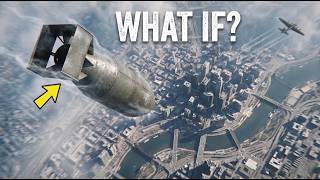 What If Every Nuclear Weapon Went Off at Once?49.8K views · 4d ago · +48/h
 What Would Happen If The Sun Disappeared For One Week?694K views · 1w ago · +377/h
 What Happens to Earth If Humans Disappear Tomorrow?680K views · 3w ago · +228/h
 What Would Happen If an Asteroid Hit the Ocean?1.4M views · 4w ago · +3.4K/h
 Nepal's 2026 Disaster: Nine Meters in 30 Minutes80.9K views · 5w ago · +22/h
 Nepal's 2026 Disaster Explained: The Glacier That Wiped Out a Valley5M views · 5w ago · +249/h
 Therizinosaurus: The Strangest Dinosaur Ever Found7.5K views · 6w ago · +2/h
 The Most Dangerous Time to Be Born As A Dinosaur14.4K views · 6w ago · +2/h
Statistics from the YouTube Data API, tracked by FameX. Views per hour, revenue and comparisons are FameX estimates.