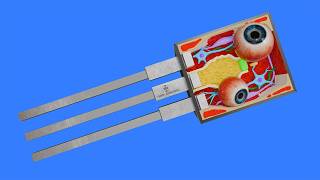
How an LED works
Long-form2:34Film & AnimationPublished Oct 19, 2026, 1:03 AM · 3d ago

Views
508,258
+4,322 views/hour
Views / hour now
4.3K
measured 2h ago
Peak views / hour
16.8K
1d ago
First 24 hours
—
not tracked from upload
Engagement
0.8%
likes + comments / views
Likes
3.6K
0.7% of views
Comments
308
0.06% of views
Est. ad revenue
$508–$1,271
lifetime, $1–2.5 RPM
Checked every 3 h while the video is this age · last check 2h ago · next in 50 min. YouTube itself updates public counts with a short delay.
Avg views / day
152K
since upload
vs channel median
0.5×
this video's views ÷ the channel's usual
Rank in channel
#18
of 20 tracked
Views over time
52 readings
Total views Views gained per hour
Description
Light-emitting diodes(LEDs) are semiconductor devices that produce light when an electric current is passed through them, an effect known as electroluminescence. Unlike incandescent lightbulbs, which generate light by heating a filament, LEDs convert electrical energy directly into photons, making them compact, durable, fast-switching and highly energy-efficient.
Electroluminescence was observed in semiconductors in the early 20th century, but the first practical visible LED appeared in 1962. Early devices were dim and mostly red, serving as indicator lights. The key breakthrough came with efficient blue LEDs in the late 1980s and early 1990s, which made practical white LED lighting possible and later earned their developers the 2014 Nobel Prize in Physics.
Modern LEDs span ultraviolet, visible and infrared wavelengths and range from microscopic emitters to multi-kilowatt lighting systems. Their applications include domestic and architectural lighting, vehicle lamps, displays, telecommunications, remote controls, machine vision, horticultural grow lights, medical instrumentation and increasingly sophisticated consumer products. Individually addressable RGB and RGBW LEDs have enabled programmable smart-lighting systems and decorative light strips, while high-CRI LED panels have become standard equipment for photography, video production and streaming.
LEDs are also used in products marketed for more specialized purposes. High-output red and near-infrared arrays are sold for photobiomodulation or "red-light therapy", including large wall panels and wearable facial masks, while narrow-spectrum LED grow lamps are widely promoted for indoor cultivation. Premium flashlights, headlamps, automotive retrofit lamps and portable video lights exploit modern high-efficiency emitters to produce outputs that would have required substantially larger electrical systems only a few decades ago.
Ongoing advances in microLEDs, phosphors and semiconductor materials continue to improve efficiency, brightness and spectral control, extending LEDs into next-generation displays, precision lighting and compact optical systems.
[3D model credit]
Farm House
by MaX3Dd
ESP32 WROOM 32 - Low Poly Photorealistic
by wojteX
Camera CANON EOS 400D
by Santiago
Stylized Game Boy - Low poly
by Coozy
5" Tri-Blade Propeller
Avatar of thevan
by The Van
Tags
LEDMicrochipComputerIT
Details
- Published
- Oct 19, 2026, 1:03 AM
- Length
- 2:34 (154 s)
- Format
- Long-form
- Category
- Film & Animation
- Audio language
- ZXX
- Quality
- HD
- Captions
- No
- Made for kids
- No
- Licensed content
- Yes
- Video ID
- ISWi_g6Cy7Y
More from WVW
 How an RV works890K views · 2w ago · +751/h
 How a Transistor works1.4M views · 4w ago · +881/h
 How a Sailing Ship works699K views · 6w ago · +91/h
 How a Concrete Truck works1.6M views · 7w ago · +500/h
 How a Vintage Car works443K views · 2mo ago · +44/h
 How a UFO works745K views · 3mo ago · +313/h
 How a Diesel Train works860K views · 3mo ago · +120/h
 How an excavator works2.2M views · 3mo ago · +480/h
Statistics from the YouTube Data API, tracked by FameX. Views per hour, revenue and comparisons are FameX estimates.